Our roots
A community older than the United States
Goshen Friends Meeting has been gathering for worship in Chester County, Pennsylvania since 1702 -- more than seventy years before the signing of the Declaration of Independence. Through every chapter of American history, this community has continued to meet, to sit in silence, and to seek together.
The meeting takes its name from Goshenville, the small settlement in what is now West Chester where early Friends lived and gathered. The land, the community, and the practice of unprogrammed worship have been constants through more than three centuries of change in the world around them.
Today Goshen Friends Meeting continues that same practice in the same spirit -- open to anyone who wants to sit in expectant silence and see what arises.
Did you know?
William Penn established Pennsylvania as a haven for Quakers and other persecuted religious groups in 1681. Friends from England and Wales began arriving almost immediately, settling in Chester County within the first decade. Goshen Monthly Meeting traces its roots to those earliest settlers.
Learn about Quaker beliefs →A brief timeline
From 1702 to today
William Penn arrives in Pennsylvania
Penn receives his charter from King Charles II and establishes Pennsylvania as a Quaker commonwealth. Welsh and English Friends begin settling Chester County almost immediately, drawn by the promise of religious freedom and fertile land.
The first gathering at Goshenville
The earliest recorded gathering of Friends in Goshenville takes place at the home of Robert Williams. A small but committed community of Quakers has established itself in the area and begins meeting regularly for worship.
Goshen Preparative Meeting established
The meeting is formally established as Goshen Preparative Meeting under the care of Uwchlan Monthly Meeting. This marks the official beginning of organized Quaker community life in Goshenville.
The first meetinghouse
A log meetinghouse is built near the burial grounds already in use by Friends, at what is now the corner of Paoli Pike and Route 352 (North Chester Road). The meeting has its first permanent home.
Growth, separation, and reunion
Like many Quaker meetings in the nineteenth century, Goshen Friends navigated the Hicksite-Orthodox separation of 1827, a significant division in American Quakerism over questions of theology and authority. The meeting continued to gather through this period and the reunification that followed in the twentieth century.
A living community
Goshen Friends Meeting continues to gather every Sunday at 10:00 AM at 814 N. Chester Road in West Chester. The meeting is part of Philadelphia Yearly Meeting, one of the oldest Quaker organizations in the world. New faces arrive each year. The silence continues.
The meeting house
A place that has held three centuries of silence
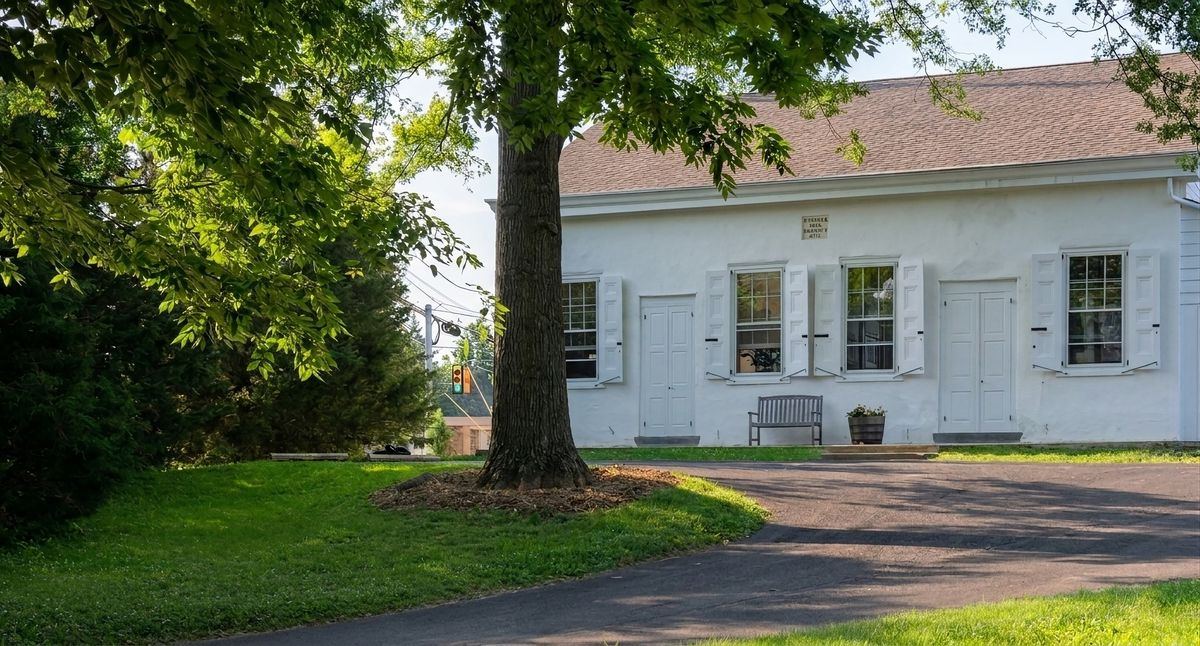
The current meeting house at 814 N. Chester Road sits on land that Friends have used for worship and burial for over three hundred years. The simple white building -- plain by design, as Quaker architecture has always been -- reflects the testimonies of simplicity and integrity that have guided Friends since the beginning.
There are no stained glass windows, no ornamentation, no altar. The room is arranged so that everyone faces one another rather than a focal point at the front. This is intentional. In Quaker worship there is no one at the front, because there is no leader. The Light, as Friends say, is present in everyone.
The burial ground on the property holds the remains of Friends who worshipped here over the centuries, many of them early settlers of Chester County whose names appear in the earliest records of Pennsylvania history.
Our wider community
Part of Philadelphia Yearly Meeting
Goshen Friends Meeting is a member of Philadelphia Yearly Meeting (PYM), one of the oldest and largest Quaker organizations in North America, founded in 1681. PYM brings together more than 100 monthly meetings across Pennsylvania, New Jersey, Delaware, and Maryland.
Yearly Meeting gathers Friends from across the region for worship, learning, and business. It provides support and resources to individual meetings and represents a connection to the broader global Quaker community.